How to Play with Stacking Cups
Be yourself; Everyone else is already taken.
— Oscar Wilde.
There are many ways you can play with the stacking cups. For my first blog post I will give you tips on how to play your child develop the skill of stacking and making it fun. Stacking is like building with blocks though they fit according to size. The different colours show a pattern though I think this gives it away- if the cups were all the same colour it would highlight the different cup sizes more clearly.
I can imagine it would be an interesting experiment if I could purchase 7 more sets of stacking cups. I could then make a yellow stacking tower, a blue one, a green one and a red one. And perhaps make different other patterns and combinations too.
You could hide objects under random cups and explore which objects according to size and quantity would fit under each cup. This is a good way to develop object permanence too. You could compare capacity using sand or water or any other materials- you could compare those too or mix the materials together for different outcomes. For example, sand mixed with water. This is the more obvious example though I’m sure you can think other others.
You could find and collect things which could be used to make your own stacking cups. You could ask questions such as, ‘Why does the base have to be a circle? Why not a square or a triangle or a star?” In fact, if you stack triangles of the same size you get a triangular prism, and if you stack circles you get a cylinder, and so on. Pulling apart and putting together 3 dimensional objects in different ways lays the foundation for future more abstract mathematical work such as working out math formulas and measuring.
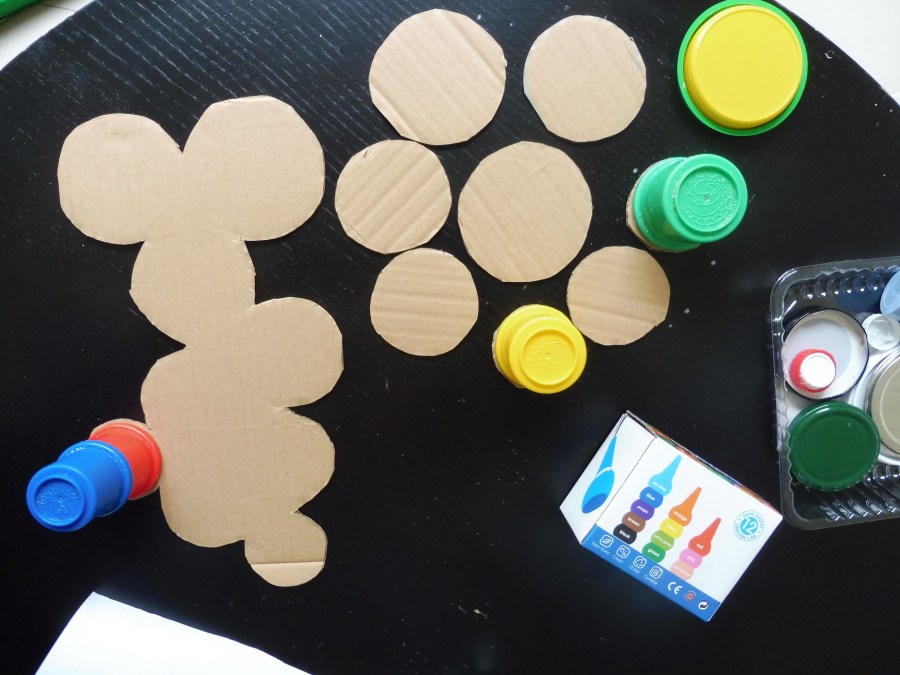
You could create art activities by tracing each stacking cup on paper or card. Cut and glue the circles to make a collage. Colour, paint or use different coloured paper. I make a matching game, much like a puzzle. You could also fold and cut each circle in half and make a collage of half circles. Using play through art and craft allows me personally to relax and enjoy trying out different ways of doing things. I can then show what I have learnt to children with more confidence and enthusiasm because I discovered it myself. Children can also make discoveries and show me in the same way. Play develops an exciting exchange of ideas! You can also use box construction material which are packaging such as egg cartons, boxes, rolls, and bottles. Watch the video for details!
Investigating the stacking cups in various ways lends itself to learning about different mathematical concepts such as circumference of a circle, measurement, sequencing size, counting, capacity, patterns, fractions and more! Once you learn to notice these concepts through play you can then use the language as you talk about what you are doing to highlight them. For example. You could point and trace the circumference of two different sized cups and say, ‘The circumference of this circle is bigger than the red one.’ And you may then ask,’why?’
If you child has the language skills to answer to not, that’s okay, in my opinion because I could then go ahead and model investigating and finding out the answer. And the great thing about this is that there are different ways of getting the same answer! This creates a quality learning experience for you and your child and you will also be able to extend the play experience to set these learning goals.
Using mathematical terminology during play, in my opinion is okay too. It’s a safe play to do so and it gets the child used to hearing it when they are having fun. So when they do formal math at school and hear those ‘big alien terminology’, they won’t get scared by it and get blocked from further learning- like I did at school.
Stacking cups fit like lids and I replicate this idea by matching them to fit the cups. Hands on experiences like this develop the child’s visual perception and their senses. This is so important to learn other mathematical concepts later on! If you’re interested, do a search on the internet for Montessori’s Pink Pyramid. This is a set of pink cubed blocks that also lays important foundation for further math, including mass.
Wouldn’t it be nice if all learning at school was hands on? There is a point when children get to a stage where they work with abstract math concepts- this is fine- this can be exciting too especially when you start working with patterns and bigger numbers- though if they haven’t had enough exposure to the 3D hands on learning they would be completely lost later on. In my opinion, play is a sophisticated way of learning so it’s appropriate for all ages- including adults like me! Emotional, physical and mental are just 3 of the endless benefits of play.
The overall aim of these play experiences is to make a model, and have a lot of fun using our creativity and imagination along the way. Many people tell me they aren’t creative or talented – I personally think this is because they may not have had the chance and time to play. The word ‘creativity’ can be a scary word too because not all people are seen to be creative- but I believe that everyone can be creative if they play!
So the process is the most important- not the end product because the process is when most of the learning takes place. This is also a time when mistakes are okay, and in fact better than okay because they may allow for other discoveries too.
Playing with your child has many benefits though the main one for me is developing a good relationship. Play allows you to spend time together and learn a lot about each other too. It creates life long memories your child will look back on. So if you’re like me, I love taking photos every now and then.
 Play Date with Maria