Learn the beginning letter sound S as you explore living and non-living things in the beautiful natural environment of Darwin Australia.
Included is the letter C to teach that it sometimes has the S sound too. Children can also learn Sh, making connections with the three sounds.
Further educational outcomes include: – Identifying and categorising living and non- living things – Vocabulary building – Names of plants and animals – Encourage interest in local natural environments and living things. – Planting the seeds for inquiry and investigative learning.
This audio visual book allows access to information by children who may not be able to read yet.
Locations are as follows: 1. Spider: East Point 2. Sulpher Crested Cockatoo: Ludmilla garden 3. Scarab Beetle: Ludmilla Garden 4. Stream: Rapid Creek 5. Seed and Cycad Tree: Ludmilla Bushblock 6. Sun dew: Ludmilla Bush Block 7. Sunset: Fitzer Drive Ludmilla Bushblock 8. Sea: City of Darwin 9. Sand, shore, shell: Casuarina Beach 10. Nightcliff Beach sunset 11. Sulpher Crested Cockatoo flying over Ludmilla Bushblock Fitzer Drive
David Percival is an expert in flora and fauna, and has teamed up with fellow colleague teacher and photographer Maria Grujicic to produce a series of nature based educational videos.
‘I showed this video to my toddler just twice and she was making the sh sound and attempting the S sound too! She wanted to hear it again and again but I recommend to take over yourself and play with the sound. Say and point to other things that start with S and sh. You could also use this as an audio. Play it as you write S with chalk or in sand. Or draw squiggles! It’s great fun.’ Maria Grujicic
We further develop our model using different kinds of blocks and toys mainly made of wood. I show you how to play with your child and pointing out the benefits. I talk about what I am doing which models language for communication, thinking and planning skills. The child also develops listening skills and builds vocabulary. We communicate about where to put each toy to create this model. Even if the child cannot talk yet, she can use utterances, facial expressions, body language and other ways to communicate. The way the child responds to the play experience such as copying also provides avenues for communication. As we build this model we are learning to work together and cooperate.
I use ‘big’ words such as ‘ecological’ and I name different objects as I point to them. The child learns by watching and imitating. Be positive and give lots of praise to develop self- esteem and confidence. Pay attention to aesthetics and creating a beautiful and organised play experience. This will instill pride and a sense of achievement, and well as learning how to organise their own play.
I talk about what each character says and does, and this leads to role play and storytelling. I recommend to take your time because this allows us to see the possibilities and enjoy the process more.
I talk about the different ways you can approach making a model – remember, there is no right or wrong. There is an unexpected twist at the end of the video to add to this play experience. Remember, this is a practice for the end product (the model we will make at the very end) and this is where most of the learning takes place. The end products of our mini projects along the way are also quite satisfying.
I show you toys and every day material to inspire creative and imaginative play. I introduce the rainbow blocks and create a model out of them, and I add other toys as I play.
The rainbow blocks are in the shape of an arc in different sizes from smallest to biggest, and look like a rainbow when stacked together. Though in my opinion, it doesn’t have to stay like that. I explore different ways to set the rainbow blocks up as I explore mathematical concepts such as a making a spiral, halves, curved shapes and lines, designs and colours.
I model how to carefully place each block, using the right pressure and control and the pincer hold, which is a pre-requisite to other skills such as using a pencil for writing or colouring. I try pushing cars under different sized arcs, and test which arcs are ‘too small’ and ‘just the right size’. This helps develop perception of size (and great fun too)!
The activity is open ended and not planned so I surprise myself when I finally make something quite cool 😉 It’s also practice for when we make our final model.
It’s interesting to experiment with blocks of different shapes and sizes. I enjoy searching for a variety to play with though less is more. I recommend to introduce a few blocks at a time not to get overwhelmed. Sorting the blocks is also a great educational activity and lends itself to different outcomes too.
To make the most of the 8 videos in this series I recommend watching them all in order. Though it’s also okay if you watch them randomly. The play experiences are filmed spontaneously and I don’t work with a script.
There are many ways you can play with the stacking cups. For my first blog post I will give you tips on how to play your child develop the skill of stacking and making it fun. Stacking is like building with blocks though they fit according to size. The different colours show a pattern though I think this gives it away- if the cups were all the same colour it would highlight the different cup sizes more clearly.
I can imagine it would be an interesting experiment if I could purchase 7 more sets of stacking cups. I could then make a yellow stacking tower, a blue one, a green one and a red one. And perhaps make different other patterns and combinations too.
You could hide objects under random cups and explore which objects according to size and quantity would fit under each cup. This is a good way to develop object permanence too. You could compare capacity using sand or water or any other materials- you could compare those too or mix the materials together for different outcomes. For example, sand mixed with water. This is the more obvious example though I’m sure you can think other others.
You could find and collect things which could be used to make your own stacking cups. You could ask questions such as, ‘Why does the base have to be a circle? Why not a square or a triangle or a star?” In fact, if you stack triangles of the same size you get a triangular prism, and if you stack circles you get a cylinder, and so on. Pulling apart and putting together 3 dimensional objects in different ways lays the foundation for future more abstract mathematical work such as working out math formulas and measuring.
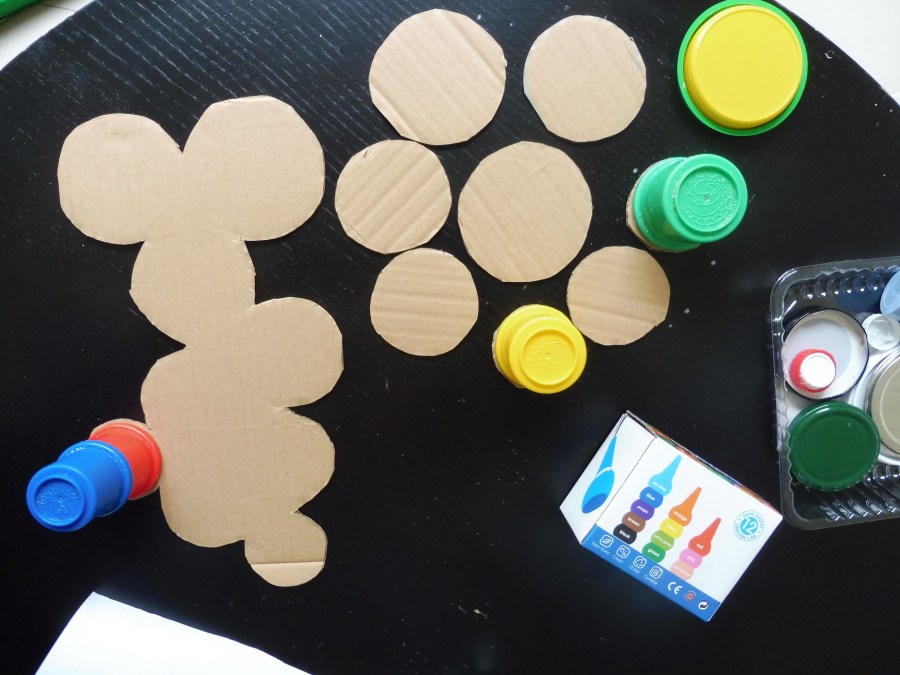
You could create art activities by tracing each stacking cup on paper or card. Cut and glue the circles to make a collage. Colour, paint or use different coloured paper. I make a matching game, much like a puzzle. You could also fold and cut each circle in half and make a collage of half circles. Using play through art and craft allows me personally to relax and enjoy trying out different ways of doing things. I can then show what I have learnt to children with more confidence and enthusiasm because I discovered it myself. Children can also make discoveries and show me in the same way. Play develops an exciting exchange of ideas! You can also use box construction material which are packaging such as egg cartons, boxes, rolls, and bottles. Watch the video for details!
Investigating the stacking cups in various ways lends itself to learning about different mathematical concepts such as circumference of a circle, measurement, sequencing size, counting, capacity, patterns, fractions and more! Once you learn to notice these concepts through play you can then use the language as you talk about what you are doing to highlight them. For example. You could point and trace the circumference of two different sized cups and say, ‘The circumference of this circle is bigger than the red one.’ And you may then ask,’why?’
If you child has the language skills to answer to not, that’s okay, in my opinion because I could then go ahead and model investigating and finding out the answer. And the great thing about this is that there are different ways of getting the same answer! This creates a quality learning experience for you and your child and you will also be able to extend the play experience to set these learning goals.
Using mathematical terminology during play, in my opinion is okay too. It’s a safe play to do so and it gets the child used to hearing it when they are having fun. So when they do formal math at school and hear those ‘big alien terminology’, they won’t get scared by it and get blocked from further learning- like I did at school.
Stacking cups fit like lids and I replicate this idea by matching them to fit the cups. Hands on experiences like this develop the child’s visual perception and their senses. This is so important to learn other mathematical concepts later on! If you’re interested, do a search on the internet for Montessori’s Pink Pyramid. This is a set of pink cubed blocks that also lays important foundation for further math, including mass.
Wouldn’t it be nice if all learning at school was hands on? There is a point when children get to a stage where they work with abstract math concepts- this is fine- this can be exciting too especially when you start working with patterns and bigger numbers- though if they haven’t had enough exposure to the 3D hands on learning they would be completely lost later on. In my opinion, play is a sophisticated way of learning so it’s appropriate for all ages- including adults like me! Emotional, physical and mental are just 3 of the endless benefits of play.
The overall aim of these play experiences is to make a model, and have a lot of fun using our creativity and imagination along the way. Many people tell me they aren’t creative or talented – I personally think this is because they may not have had the chance and time to play. The word ‘creativity’ can be a scary word too because not all people are seen to be creative- but I believe that everyone can be creative if they play!
So the process is the most important- not the end product because the process is when most of the learning takes place. This is also a time when mistakes are okay, and in fact better than okay because they may allow for other discoveries too.
Playing with your child has many benefits though the main one for me is developing a good relationship. Play allows you to spend time together and learn a lot about each other too. It creates life long memories your child will look back on. So if you’re like me, I love taking photos every now and then.
Learn how to play with your child at home and choose quality educational toys. Blend the toys together to create awesome combinations and creations. Same money and time – I teach you what to look for in a good toy. 🙂
Come and have a play date with Maria!
I believe that less is more.
It’s what you do with the toys that’s important and how you play- HAVE FUN! Plus learn to watch for all the endless educational benefits of your spontaneous play experiences with your child(ren).
I started a series of videos to motivate myself and reflect on my stay at home mum job. I also missed teaching and sharing ideas with others. Bub appreciates my efforts 😉 and I achieved my main goal so far- to have fun playing as much as we can.
You can find these videos on my Youtube channel and Facebook ‘Maria’s Playground’.
I believe I am the best person to teach my child, and I don’t want to miss out on all the exciting milestones. These are also wonderful irreplaceable experiences and a lifetime of memories. This to me is the greatest reward – and the most important job in the world!
Before I became a mummy I was a teacher to some great kids and taught with some wonderful teachers. I studied a lot- some of these courses were Montessori, Early Childhood Education, Music, Twice Exceptional Giftedness, Special Education, and have had over 20 years teaching in different places of the world including Australia- where I now live. I believe that my home life which was rich in play was what motivated me do continue being creative and using my imagination to still play.
I also enjoy creating songs, stories, dance, games, editing movies and lots of other things. I love play because it opens up ENDLESS opportunities. Plus, in my late forties it keeps me feeling forever young 😉 So join me if you can in my world of play.
Why do this?
So instead of being that shy little girl who confirmed I’m excited to have this platform to express myself and showcase my work. I’m a people person and enjoy talking with people who have similar aspirations. Though in the past I haven’t grasped hold of my big dream. Although I’ve enjoyed the journey getting there I’d like to finally achieve it before I am too old to enjoy it.
If you’re a parent, teacher, student or anyone working with children or you’d also like to reflect on your childhood I’d like to hear your thoughts too. It’s important to me that I connect with others. I don’t specifically remember what I did at a child – I only recall what gave me joy. My students who are now adults tell me my classes were fun. Play is a gift that comes in many forms and it’s for all ages!
As parents we can play a big part of our children’s future. So often I’ve heard parents push for the academics. Play can provide a more holistic approach to education which means children get a bigger picture of the world which is hands on- at their reach and they can develop their own ideas. They can explore answers to questions and with a lot more scope for key learning than sitting amd listening to a teacher who stands at the front of the class feeding knowledge. This often doesn’t sink in because not every child is interested. I was one if them- I drifted off on a day dream while the teacher thought I was being a good girl. Through play children follow their interests and they enjoy learning. I was more myself at home. Not that I hated school – I just didn’t have the same opportunities.
At school I enjoyed the extra- curricular activities such as art, dance, music and sport. But this made up just a small percentage of what was taught. I also enjoyed handwriting and mapping and the other academics but these can also be integrated into these extra-curricular subjects .
I’ve written many other blogs but have hidden behind the achievements of others and helped them along. This time I hope I can have the courage to shine.
I hope that the every day play experiences with my child will grow and form into the topics I will write about on my blog.
I hope to connect with people who are like-minded.
Within the next year I hope to have started up something that I’ve always dreamt I would do but the timing was never right.
I’ve reach some of my dreams. I’ve written dozens of poems for adults and children. It was a period of frenzy- I couldn’t stop even if I wanted to. It was like my soul took over. I published a few books too. Play was what inspired me. Through my childhood I spent a lot of time alone day dreaming and playing. Sometimes with my brothers too. We had a big yard and a trampoline. We ran around and played all day.
We pretended to be protagonists and acted out scenes we watched on TV like Doctor Who. It scared me and interested me at the same time, and play was a safe way to explore my feelings.
So for my next personal project I’d like to illustrate my own picture books for children. I got others to do this and although I appreciate their help, they didn’t quite capture what was in my head. The beauty of imagination is that it’s yours. Like a personal signature and it’s extraordinarily fun! Where would childhood be without play?


 Play Date with Maria